Customer Logins

Obtain the data you need to make the most informed decisions by accessing our extensive portfolio of information, analytics, and expertise. Sign in to the product or service center of your choice.

Customer Logins

My Logins

All Customer Logins
S&P Global
Explore S&P Global
  • S&P Global
  • S&P Dow Jones Indices
  • S&P Global Market Intelligence
  • S&P Global Mobility
  • S&P Global Commodity Insights
  • S&P Global Ratings
  • S&P Global Sustainable1
Close
Discover more about S&P Global’s offerings.
Investor Relations
  • Investor Relations Overview
  • Presentations
  • Investor Fact Book
  • News Releases
  • Quarterly Earnings
  • SEC Filings & Reports
  • Executive Committee
  • Merger Information
  • Governance
  • Stock & Dividends
  • Shareholder Services
  • Contact
English
  • Español
  • 中文网站
  • Português
  • 한국어
  • हिंदी
  • 日本語
Support
  • Get Support
  • System Notifications
  • Delivery Platforms
  • Regulatory Engagement
Login
  • Commodity Insights Login
  • Access IHS Markit Products
Register
logo Commodity Insights
  • Commodities
  • Products & Solutions
  • News & Research
  • Pricing & Benchmarks
  • Events
  • Sustainable1
  • Who We Are
  • S&P Global
  • S&P Dow Jones Indices
  • S&P Global Market Intelligence
  • S&P Global Mobility
  • S&P Global Commodity Insights
  • S&P Global Ratings
  • S&P Global Sustainable1
  • Oil Upstream LNG Natural Gas Electric Power Coal Shipping Chemicals Metals Agriculture
    Latest in Commodities
    Listen: Change Makers: Rodney Clemente, Energy Recovery

    Energy Recovery, with roots in the desalination industry, designs and manufactures energy-efficiency...

    India woos upstream oil and gas investors with changes on revenue sharing, fiscal incentives

    India has unveiled a new set of policies for its oil and gas sector, under which it aims to offer a...

    PACIFIC LNG: Key market indicators for July 14-18

    Platts JKM, the benchmark price reflecting LNG delivered to Northeast Asia, is expected to stay firm...

  • Agriculture & Food Biofuels Chemicals Fertilizers Clean Energy Technology Gas & Power Crude Oil Fuels & Refined Products LNG Steel & Metals Upstream & Midstream (Oil & Gas) Crop Science Carbon & Scenarios Shipping
    Capabilities
    Market Insights and Analytics CI Consulting Commodity Prices and Essential Market Data Real-Time News, Prices and Analysis Forward Curves and Risk Valuation Data
    Data and Distribution
  • Latest News Headlines All Topics Videos Podcasts Special Reports Infographics Insight Blog    Commodity Insights Magazine Commodity Insights LIVE
  • Our Methodology Methodology & Specifications Price Assessments Subscriber Notes Price Symbols Symbol Search & Directories Corrections Complaints
    References
    Market On Close Index Methodology Review & Change MOC Participation Guidelines Holiday Dunl.org SEE ALL REFERENCE TOOLS
  • All Events Webinars Conferences Methodology Education Training and eLearning Forums Conferences Live Global Energy Awards    CERAWeek
    Featured Events
    Webinars Watt's new in the current affairs of Battery Metals
    • 28 Aug 2025
    • Online
    Webinars APPEC 2025
    • 28 Aug 2025
    • Online
    Webinar Madrid Market Briefing
    • 16 Sep 2025
    • Madrid, Spain
  • Overview Contact Us Regulatory Engagement & Market Issues Commodity Insights LIVE

Sulfur

Chemical Economics Handbook

View Report for existing customers Go to Customer Login for existing customers
Learn more about Sulfur
Contact Sales
Contact Sales +1 844 301 7334

Published March 2024

Sulfur is one of the chemical industry’s most important raw materials. It is used principally as the derivative (sulfuric acid) in many chemical and industrial processes and is particularly important in the manufacture of phosphate fertilizers, the single largest end use for sulfur. Other key uses include rubber processing, cosmetics, and pharmaceutical applications. Sulfur’s importance to industrial economies and its relative ease of transportation have made it a commodity of major international interest. It is derived as a by-product from operations such as petroleum refining, tar sands recovery, heavy oil and natural gas processing, and from coking and metallurgical plants.

In the past five years, sulfur production has been affected by reduced natural gas processing, a shift in feedstock mixes from sour to slightly sweet crude, depletion of certain natural gas fields, and changes in demand from some types of fuel. However, production increased by more than 8% per year, with new plants developed in the Middle East and mainland China’s growing coal chemical industry that has developed strict environmental standards, which has led to the establishment of many sulfur recovery plants.

The following chart shows world consumption of sulfur:
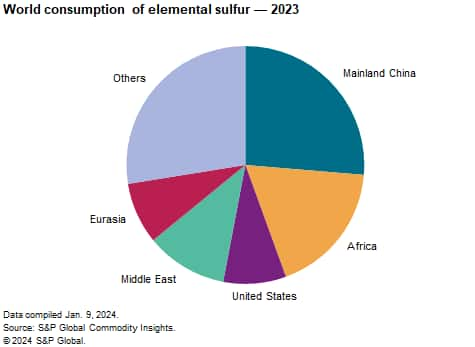
Approximately 90%-95% of elemental sulfur recovered is used to produce sulfuric acid. In recent years, sulfur use is increasing as a nutrient through ammonium phosphate derivatives and NPK compounds that are blended with sulfur. Fertilizers are the ultimate use of about 50% of the world’s sulfur production. Phosphate fertilizer production accounts for about 85% of this total, but ammonium sulfate production is also significant. Thus, the sulfur market is very dependent on the cyclical global phosphate fertilizer market. Phosphate production in mainland China plays an important role in determining sulfur requirements. Africa has also gained importance as a significant global importer of sulfur and is currently the largest importer. Demand from downstream products such as sulfuric acid–based single superphosphate and potassium sulfate contributes to sulfur demand. There are no substitutes for phosphates in their role as a plant nutrient. After a recent slump, there are indications that sulfur demand is improving, given that the production of di- and monoammonium phosphate in mainland China has been increasing. A similar increase in demand is also happening in India. Although these plants are designed primarily to produce ammonium phosphates, they are often used to produce NPK fertilizers as well as sulfur as a nutrient.

Global sulfur supply is expected to continue to grow from both crude refining and natural gas processing operations. Future production will occur mostly in the Middle East, Asia and Eurasia, while regions like North America, Western Europe and Japan are likely to experience reduced production levels. Potential expansions in the UAE as well as projects in Kuwait, Qatar, Oman, Turkey and Saudi Arabia are adding significant supplies as a result of hydrocarbon processing. Several expansions/upgrades in Eastern Europe will result in sulfur production increases. Much of the new supplies from the Middle East will satisfy demand from new upcoming phosphate production in Saudi Arabia and Morocco. This could lead to production rationalization in regions that export to the Middle East.

In the medium to long term, sulfur supply will be affected by the emergence of abundant shale gas. An increase in shale gas production could lead to a decrease in production from current sulfur sources, resulting in lower production from oil and natural gas sources. This could lead to increased prices. However, increasing extraction from poorer-quality gas and crude oil, along with oil sands production, is expected to lead to increased sulfur production, mitigating the supply situation. Additionally, with stringent standards coming into force in Asia on low-sulfur gasoline and diesel, along with IMO regulations on bunker fuel sulfur content, sulfur production may increase. Bunker fuel demand has been growing at around 3% per year for quite some time, and an increase in bunker fuel consumption with minimal sulfur content could increase sulfur availability. Total demand, however, is not expected to change. Sulfur content in bunker fuels used in seaborne vessels has been reduced to 0.5% starting in 2020, significantly lower than the previous level of 3.5%.

Most of the growth will be in the Middle East, which is expected to become the top sulfur-producing region, followed by Eurasia and mainland China. Potential expansions in the UAE as well as projects in Kuwait, Qatar, Oman, Turkey and Saudi Arabia are adding significant supplies as a result of hydrocarbon processing. Some parts of Europe will experience a decrease in production. Eastern Europe and Central Asia will continue to add supplies. Several expansions/upgrades in Russia will result in sulfur production increases.

For more detailed information, see the table of contents, shown below.

S&P Global’s Chemical Economics Handbook –Sulfur is the comprehensive and trusted guide for anyone seeking information on this industry. This latest report details global and regional information, including

Key benefits

S&P Global’s Chemical Economics Handbook –Sulfur has been compiled using primary interviews with key suppliers and organizations, and leading representatives from the industry in combination with S&P Global’s unparalleled access to upstream and downstream market intelligence and expert insights into industry dynamics, trade and economics.

This report can help you

  • Identify trends and driving forces influencing chemical markets
  • Forecast and plan for future demand
  • Understand the impact of competing materials
  • Identify and evaluate potential customers and competitors
  • Evaluate producers
  • Track changing prices and trade movements
  • Analyze the impact of feedstocks, regulations, and other factors on chemical profitability

Buy individual report now Contact:
customercare@ihsmarkit.com
Find the chemical expertise you need Contact a chemical expert or request a demo today.
GET STARTED

Table of Contents

Section Page Number

Executive summary7
Summary9
Introduction15
Properties and grades16
Sources and recovery17
Reserves and resources17
Recovery17
Elemental18
Elemental sulfur from salt domes and evaporites (Frasch)18
By-product sulfur recovered from hydrocarbons18
Volcanic deposits19
Contained sulfur19
Other and potential sources19
Coal and shale20
Gypsum20
Other20
Environmental issues21
Supply and demand by region25
World25
Capacity25
Salient statistics26
Consumption27
Price29
Trade30
United States31
Producing companies31
Salient statistics35
Consumption37
Sulfuric acid39
Sulfur bentonite39
Pulp and paper40
Carbon disulfide40
Phosphorus pentasulfide41
Rubber vulcanizing41
Sulfur dioxide41
Other42
Direct agricultural applications42
Sulfur trioxide for surface-active agents and chlorosulfonic acid42
Sulfur polymer cement concrete43
Miscellaneous43
Price44
Trade45
Canada46
Producing companies46
Salient statistics48
Consumption50
Price52
Trade53
Mexico54
Producing companies54
Salient statistics55
Trade58
Central and South America59
Producing companies59
Salient statistics61
Consumption64
Trade65
Western Europe66
Producing companies66
Production capacity70
Salient statistics72
Production72
Consumption 74
Sulfuric acid 77
Sulfur dioxide77
Carbon disulfide77
Rubber vulcanizing 78
Hydrogen sulfide78
Sulfur bentonite78
Other78
Price78
Trade79
Central and Eastern Europe81
Producing companies81
Production capacity83
Salient statistics85
Production85
Consumption 87
Trade90
Eurasia92
Producing companies92
Production capacity96
Salient statistics97
Production98
Consumption 99
Price102
Trade103
Middle East104
Producing companies104
Production capacity111
Salient statistics113
Production113
Consumption 115
Price118
Trade119
Africa 120
Producing companies 120
Production capacity 123
Salient statistics 124
Production 125
Consumption 127
Price130
Trade 131
Mainland China 133
Producing companies 133
Salient statistics 143
Production 145
Consumption 146
Sulfuric acid 147
Miscellaneous use 147
Carbon disulfide147
Sulfur dioxide148
Rubber vulcanizing 148
Sugar processing 148
Direct agricultural applications 148
Pesticides 148
Other uses 148
Price 148
Trade 149
Northeast Asia 150
Overview 150
Producing companies 150
Salient statistics 152
Production 152
Consumption 153
Trade 156
Japan 157
Salient statistics 157
Production 158
Consumption 159
Trade 161
South Asia 161
Overview 161
Producing companies 161
Salient statistics 163
Production 164
Consumption 165
Trade 168
India 169
Salient statistics 169
Production 170
Consumption 171
Price 173
Trade 174
Southeast Asia 174
Producing companies 174
Salient statistics 176
Production 177
Consumption 178
Trade 181
Additional resources183
Revisions184
Data Workbook185

Products & Solutions from related industries

Chemical Image

Acetic Acid - Chemical Economics Handbook (CEH)

Chemical Image

Acetaldehyde - Chemical Economics Handbook (CEH)

Chemical Image

Acetone - Chemical Economics Handbook (CEH)

Chemical Image

Acetonitrile - Chemical Economics Handbook (CEH)

Chemical Image

Acetic Anhydride - Chemical Economics Handbook (CEH)

Chemical Image

Acetylene - Chemical Economics Handbook (CEH)

Chemical Image

Acrylamide - Chemical Economics Handbook (CEH)

Chemical Image

Acrylic Acid, Acrylate Esters and Polymers - Chemical Economics Handbook (CEH)

Chemical Image

Acrylic and Modacrylic Fibers - Chemical Economics Handbook (CEH)

Chemical Image

Acrylic Surface Coatings - Chemical Economics Handbook (CEH)

Chemical Image

Acrylonitrile-Butadiene-Styrene (ABS) Resins -Chemical Economics Handbook-CEHl Economics Handbook (CEH)

Chemical Image

Acrylonitrile - Chemical Economics Handbook (CEH)

Chemical Image

Activated Carbon - Chemical Economics Handbook (CEH)

Chemical Image

Adipic Acid - Chemical Economics Handbook (CEH)

Chemical Image

Air Separation Gases - Chemical Economics Handbook (CEH)

Chemical Image

Alkyd/Polyester Surface Coatings - Chemical Economics Handbook (CEH)

Chemical Image

Alkyl Acetates - Chemical Economics Handbook (CEH)

Chemical Image

Alkylamines (C1-C6) - Chemical Economics Handbook (CEH)

{"items" : [ {"name":"share","enabled":true,"desc":"<strong>Share</strong>","mobdesc":"Share","options":[ {"name":"facebook","url":"https://www.facebook.com/sharer.php?u=http%3a%2f%2fssl.ihsmarkit.com%2fcommodityinsights%2fen%2fci%2fproducts%2fsulfur-chemical-economics-handbook.html","enabled":true},{"name":"twitter","url":"https://twitter.com/intent/tweet?url=http%3a%2f%2fssl.ihsmarkit.com%2fcommodityinsights%2fen%2fci%2fproducts%2fsulfur-chemical-economics-handbook.html&text=Sulfur+-+Chemical+Economics+Handbook+(CEH)+%7c+S%26P+Global","enabled":true},{"name":"linkedin","url":"https://www.linkedin.com/sharing/share-offsite/?url=http%3a%2f%2fssl.ihsmarkit.com%2fcommodityinsights%2fen%2fci%2fproducts%2fsulfur-chemical-economics-handbook.html","enabled":true},{"name":"email","url":"?subject=Sulfur - Chemical Economics Handbook (CEH) | S&P Global&body=http%3a%2f%2fssl.ihsmarkit.com%2fcommodityinsights%2fen%2fci%2fproducts%2fsulfur-chemical-economics-handbook.html","enabled":true},{"name":"whatsapp","url":"https://api.whatsapp.com/send?text=Sulfur+-+Chemical+Economics+Handbook+(CEH)+%7c+S%26P+Global http%3a%2f%2fssl.ihsmarkit.com%2fcommodityinsights%2fen%2fci%2fproducts%2fsulfur-chemical-economics-handbook.html","enabled":true}]}, {"name":"rtt","enabled":true,"mobdesc":"Top"} ]}
Filter Sort
  • About S&P Global Commodity Insights
  • Media Center
  • Advertisers
  • Careers
  • Contact Us
  • History
  • Glossary
  • S&P Global Inc.
  • Our Values
  • Overview
  • Investor Relations
  • Customer Care & Sales
  • Careers
  • Our History
  • News Releases
  • Support by Division
  • Get Support
  • Corporate Responsibility
  • Ventures
  • Quarterly Earnings
  • Report an Ethics Concern
  • Leadership
  • Press
  • SEC Filings & Reports
  • Office Locations
  • IOSCO ESG Rating & Data Product Statements
  • © 2025 by S&P Global Inc. All rights reserved.
  • Terms of Use
  • Cookie Notice
  • Privacy Policy
  • Client Privacy Portal
  • Do Not Sell My Personal Information
  • Site Map