Customer Logins
Obtain the data you need to make the most informed decisions by accessing our extensive portfolio of information, analytics, and expertise. Sign in to the product or service center of your choice.
Customer Logins

BLOG
Mar 09, 2020
Fast Transition: Defining a pathway to 90% decarbonization of electric power in North America


Greenhouse gas emissions in the power sector are down 27% in the United States and 36% in Canada since 2005. This transition has been driven to a large extent by the abundance of low-cost natural gas, coal generation retirement, and the growth of renewables. Current state, provincial, and federal-level policies, as well as the availability of low-cost renewable resources, will drive further power sector decarbonization, but multistate and provincial coordination will likely become more difficult and maintaining reliability more expensive, posing headwinds that only further national policy will be able to counter.
The IHS Markit Planning Case anticipates US and Canadian power sectors achieving 64% and 57% emissions reductions by 2050. Though there is notable renewable growth in both countries, low-cost natural gas retains a significant market share, limiting steeper declines. The Planning Case also assumes a relatively "light hand" on the electrification of non-electric energy end uses, and as a result, economy-wide carbon emissions decline only 20% and 2% by 2050 in the United States and Canada relative to 2005 levels.
Fast Transition represents a major departure from the Planning Case
IHS Markit's recently released "Fast Transition Case" considers deep decarbonization of the US and Canadian economies, with a strong focus on energy end use electrification, paralleled by power sector deep decarbonization. Critical elements of the deep (over 90%) power sector decarbonization include:
- The phase-out of conventional coal
- Development of carbon capture and sequestration
- Increased success in nuclear plant life extensions
- Significant renewable and storage capacity additions
The accelerated transition is underpinned by an all-of-the-above policy push at the national and subnational level. The combined policy push of end-use electrification and power sector decarbonization achieves economy-wide carbon emission reductions exceeding 70% in both the United States and Canada.
Fast Transition's low-CO2 power supply mix evolves in two phases. Initially, generation capacity additions ramp up well beyond historical levels, as energy end-use electrification leads to substantial demand growth. Later, from the mid-2030s onward, the generation mix is increasingly dominated by the goal of having the power system's carbon emissions 90% below 2005 levels by 2050, with new additions pushing out the remaining emitting resources.
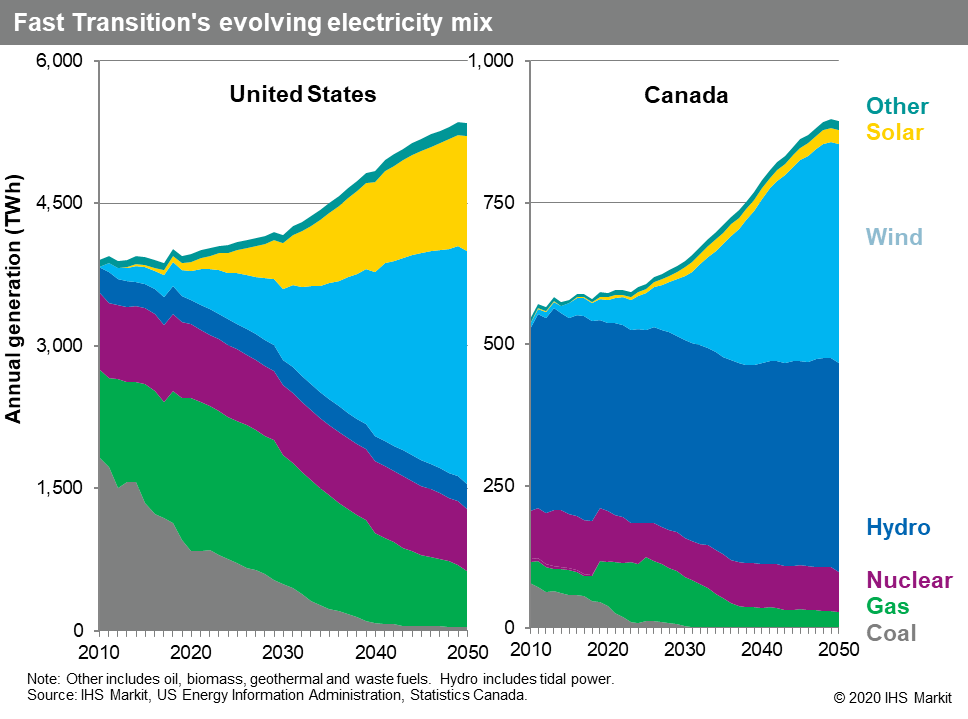
Figure 1: Fast Transition's evolving electricity mix.
Clean energy development reflects regional resource abundance
State and provincial ambitions and federal policy support combine to drive a nearly tenfold growth of wind and solar capacity in the United States and Canada.
- The relative levels of renewable development are driven by regional resource abundance, the amount of fossil-fueled power that needs to be replaced, expected demand growth, and the potential for transmission development.
- Offshore wind plays a modest role in Fast Transition. In regions with coastal access, offshore wind accounts for about 30% of total US wind build. Offshore wind accounts for about 20% of total US wind development overall.
- Solar capacity, with its advantage of siting flexibility, amounts to a majority of the US total clean energy capacity increase. Wind capacity additions are regionally dominant over solar only in ERCOT, the US Pacific Northwest, and Canada. However, wind, with its better capacity factors, dominates renewable energy growth in both countries.
Power sector reliability is maintained with a mix of flexible resources
A key challenge in achieving over 90% power sector decarbonization is maintaining system reliability to meet daily, monthly, and seasonal variations in power demand and renewable resource availability. Fast Transition provides this reliability with:
- Hundreds of gigawatts of batteries with storage durations of up to 10 hours
- Much of the conventional natural gas‒fired power assets remain online and operate flexibly and at overall low capacity factors, typically under 5% for combustion turbines and 20% for combined cycles in the late 2040s.
- Geothermal and gas CCS have the potential to operate in a flexible mode, meeting daily fluctuations in demand, as opposed to their typical base-load usage today.
IHS Markit closely monitors the North American energy markets, publishing data, key insights and market analysis. Learn more about our research.
Patrick Luckow is an associate director of Gas, Power,
and Energy Futures at IHS Markit.
Mark Griffith is a director of Gas, Power, and
Energy Futures at IHS Markit.
Posted 09 March 2020.
This article was published by S&P Global Commodity Insights and not by S&P Global Ratings, which is a separately managed division of S&P Global.
{"items" : [
{"name":"share","enabled":true,"desc":"<strong>Share</strong>","mobdesc":"Share","options":[ {"name":"facebook","url":"https://www.facebook.com/sharer.php?u=http%3a%2f%2fssl.ihsmarkit.com%2fcommodityinsights%2fen%2fci%2fresearch-analysis%2ffast-transition-defining-a-pathway-to-90-decarbonization.html","enabled":true},{"name":"twitter","url":"https://twitter.com/intent/tweet?url=http%3a%2f%2fssl.ihsmarkit.com%2fcommodityinsights%2fen%2fci%2fresearch-analysis%2ffast-transition-defining-a-pathway-to-90-decarbonization.html&text=Fast+Transition%3a+Defining+a+pathway+to+90%25+decarbonization+of+electric+power+in+North+America+%7c+S%26P+Global+","enabled":true},{"name":"linkedin","url":"https://www.linkedin.com/sharing/share-offsite/?url=http%3a%2f%2fssl.ihsmarkit.com%2fcommodityinsights%2fen%2fci%2fresearch-analysis%2ffast-transition-defining-a-pathway-to-90-decarbonization.html","enabled":true},{"name":"email","url":"?subject=Fast Transition: Defining a pathway to 90% decarbonization of electric power in North America | S&P Global &body=http%3a%2f%2fssl.ihsmarkit.com%2fcommodityinsights%2fen%2fci%2fresearch-analysis%2ffast-transition-defining-a-pathway-to-90-decarbonization.html","enabled":true},{"name":"whatsapp","url":"https://api.whatsapp.com/send?text=Fast+Transition%3a+Defining+a+pathway+to+90%25+decarbonization+of+electric+power+in+North+America+%7c+S%26P+Global+ http%3a%2f%2fssl.ihsmarkit.com%2fcommodityinsights%2fen%2fci%2fresearch-analysis%2ffast-transition-defining-a-pathway-to-90-decarbonization.html","enabled":true}]}, {"name":"rtt","enabled":true,"mobdesc":"Top"}
]}