Customer Logins
Obtain the data you need to make the most informed decisions by accessing our extensive portfolio of information, analytics, and expertise. Sign in to the product or service center of your choice.
Customer Logins

BLOG
Jan 15, 2021
What does “Green” really mean?
Braskem has popularized "Green" polyethylene. Now, the question is what does "Green" really mean? When I joined the petrochemical industry back in the day, if someone said a plastic was green, it implied the plastic would be biodegradable. Today, the meaning of green has an additional meaning, that is the plastic was made from a renewable resource. And that is how Braskem means it. Braskem takes bioethanol made via fermentation of sugar from sugarcane and dehydrates it to ethylene and in turn this green ethylene is polymerized to green high density polyethylene.

This whole area of what constitutes a "green" plastic is very
confusing and industry participants, and especially consumers, may
have different notions of what this term "green" really means. To
illustrate some of the different products claiming "greenness", I
put together this chart which I use in my training course,
"Understanding the Global
Petrochemical Industry". I call it "The Many
Shades of Green".
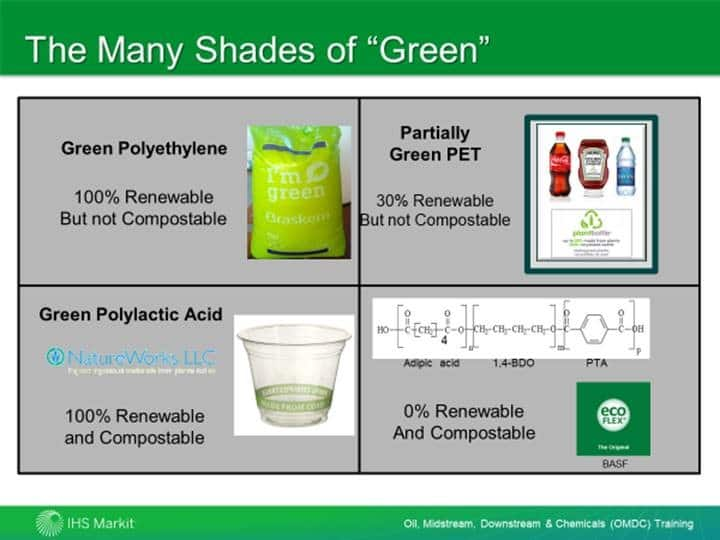
On the upper left, is Braskem's green polyethylene. It's made from a renewable feedstock but it is not compostable or biodegradable. Its properties are identical to petrochemical HDPE in every other respect. On the upper right is Coca-Cola's Plant bottle. This plastic bottle is polyethylene terephthalate or PET made by reacting petrochemical-based PTA and renewable MEG. The renewable MEG is made by reacting green ethylene from bioethanol (in the same way Braskem does it) and then using conventional technology the green ethylene is converted to green MEG. Thus, the resulting PET is 30% renewable. But again, just like Braskem's green polyethylene, the Plant bottle will not be compostable or biodegradable. Its properties are identical to 100% petrochemical-based PET bottles. On the lower left, is an example of Nature Works green polylactic acid.This plastic is 100% made from renewable resources and is compostable. But to fair, this plastic will only biodegrade in commercial facilities using appropriate conditions. And finally, to add additional complexity, on the lower right is a BASF product, Eco Flex. This plastic is 0% renewable, in other words made totally from petrochemical-based feedstocks but yet is designed to be compostable.
I think you would agree that there are a bunch nuances to this whole area that I think are not appreciated by consumers and even to many in the plastics business.
And now, Sumitomo has a new twist.
Sumitomo has recently announced that they are licensing Axens' ethanol-to ethylene technology as a piece in the puzzle to develop a circular waste-to-polyethylene project in Japan. Axens' technology, registered as Atol, is based upon catalytic dehydration of 1st or 2nd generation bioethanol to give bio-ethylene. Axens claims 99+% ethanol conversion per pass, close to stoichiometric ethylene yield, and ethylene purity of up to 99.9%.
The key to making this approach circular is the production technology that will be employed by Sumitomo to make the bioethanol. In early 2020, Sumitomo had announced they were cooperating with SEKISUI CHEMICAL to transform waste into ethanol. In late 2017, and SEKISUI CHEMICAL in a joint development effort with LanzaTech Inc. developed technology to gasify waste to syngas (a mixture of carbon monoxide and hydrogen) and convert the syngas into ethanol using bio-catalysis.
Thus, putting all of these company's pieces together, Sumitomo, Axens, SEKISUI CHEMICAL, and LanzaTech will allow for a completely circular route to polyethylene. Sumitomo hopes to pilot the project in 2022 with full scale commercialization in 2025.
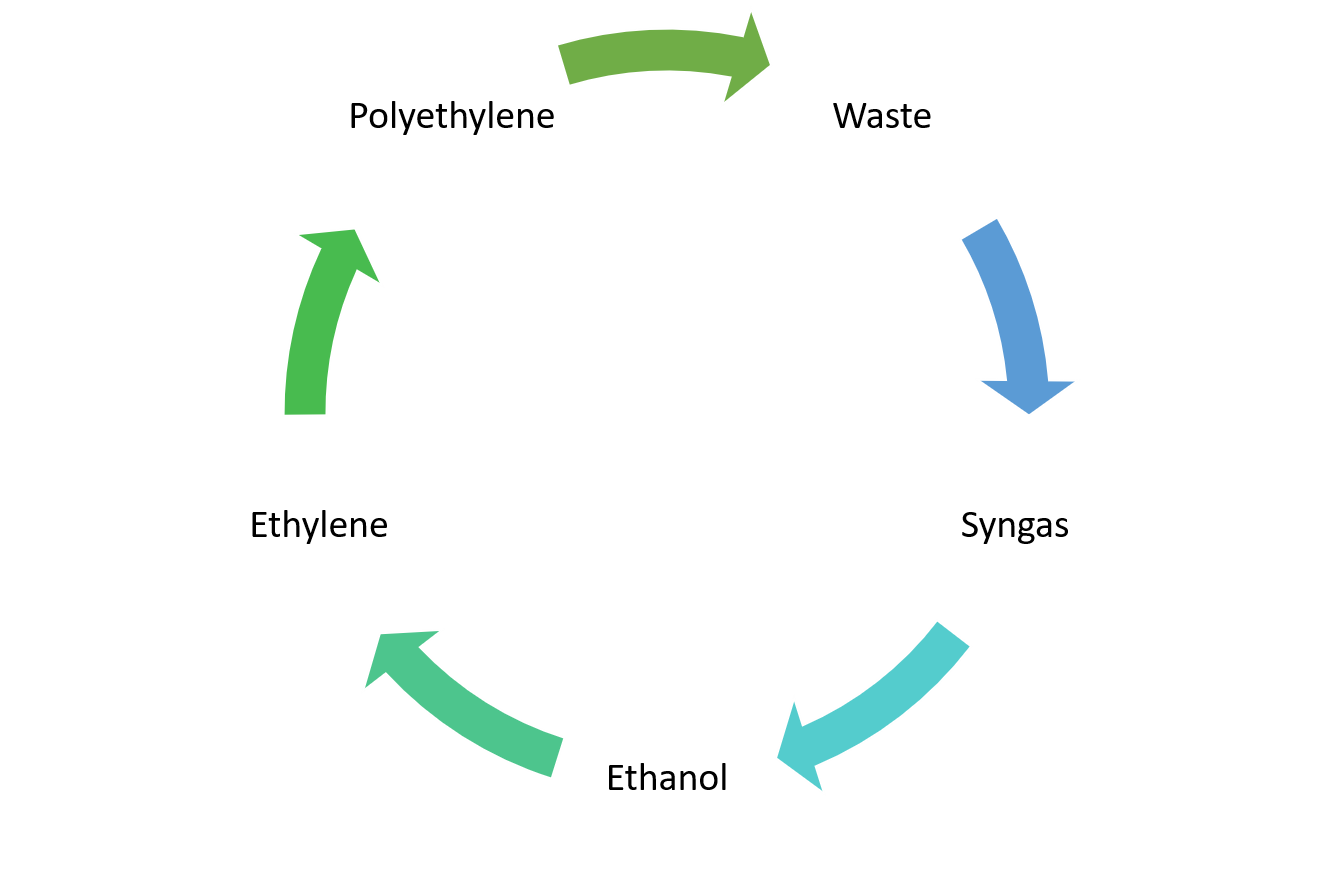
This is a great way to demonstrate that to solve the plastic waste issue it will take a lot of collaboration as no one company will likely have the skillset and experience to develop all of the necessary pieces in the puzzle.
To learn more about polyethylene and the petrochemical industry as a whole, take a look at my Understanding the Petrochemical Industry training.
{"items" : [
{"name":"share","enabled":true,"desc":"<strong>Share</strong>","mobdesc":"Share","options":[ {"name":"facebook","url":"https://www.facebook.com/sharer.php?u=http%3a%2f%2fssl.ihsmarkit.com%2fcommodityinsights%2fen%2fci%2fresearch-analysis%2fwhat-does-green-really-mean-polyethylene.html","enabled":true},{"name":"twitter","url":"https://twitter.com/intent/tweet?url=http%3a%2f%2fssl.ihsmarkit.com%2fcommodityinsights%2fen%2fci%2fresearch-analysis%2fwhat-does-green-really-mean-polyethylene.html&text=What+does+%e2%80%9cGreen%e2%80%9d+really+mean%3f+++%7c+S%26P+Global+","enabled":true},{"name":"linkedin","url":"https://www.linkedin.com/sharing/share-offsite/?url=http%3a%2f%2fssl.ihsmarkit.com%2fcommodityinsights%2fen%2fci%2fresearch-analysis%2fwhat-does-green-really-mean-polyethylene.html","enabled":true},{"name":"email","url":"?subject=What does “Green” really mean? | S&P Global &body=http%3a%2f%2fssl.ihsmarkit.com%2fcommodityinsights%2fen%2fci%2fresearch-analysis%2fwhat-does-green-really-mean-polyethylene.html","enabled":true},{"name":"whatsapp","url":"https://api.whatsapp.com/send?text=What+does+%e2%80%9cGreen%e2%80%9d+really+mean%3f+++%7c+S%26P+Global+ http%3a%2f%2fssl.ihsmarkit.com%2fcommodityinsights%2fen%2fci%2fresearch-analysis%2fwhat-does-green-really-mean-polyethylene.html","enabled":true}]}, {"name":"rtt","enabled":true,"mobdesc":"Top"}
]}