Customer Logins
Obtain the data you need to make the most informed decisions by accessing our extensive portfolio of information, analytics, and expertise. Sign in to the product or service center of your choice.
Customer Logins

BLOG
Jan 14, 2014
Optimizing water management through the phases of asset development
The most water intensive phase of unconventionals development is the exploitation and optimization phase. Water interruption is best avoided by proper planning for the key critical factors.
This is the first in a series of articles drawing on IHS research that explores the complexities of water management throughout the development of unconventional oil and gas resources. This first article focuses on the exploitation and optimization phase which is the most water intensive of the three phases of oil and gas development.
Oilfield water management is a complex optimization challenge balancing operational risk, economic performance, and enterprise sustainability throughout the life of a field. Furthermore, water management strategies change significantly as operators transition through each of the three phases of asset development. IHS research reveals that best practices in water management change considerably as operations move from holding acreage by production, through exploitation and optimization to mature field water management.
Many factors determine an E&P company's water management strategy. Primary among them are the availability of disposal wells and freshwater sources, the regulatory climate, the fracture fluid chemistry, and the quality and quantity of flowback fluid and produced fluid collectively called "wastewater." This article focuses on water management strategies during the exploitation and optimization phase. Future articles will address in detail each of the primary factors responsible for shaping water management strategies.
Three phases of field development relevant to water management
Optimal water management depends on the phase of asset development. Each phase has differing demands for fracture fluids, as well as differing quality and quantity of wastewater generated, in addition to other operational considerations.
- Phase 1: Held by production (HBP) drilling and experimentation. During this phase, operators seek to accomplish at least two concurrent goals. First, they want to hold as many leases as possible by production in order to protect land investments. Second, operators start to assess the productivity of the acreage position.
- Phase 2: Exploitation and optimization. During this phase, most acreage positions are held by production, the boundaries of productive acreage are established, and operators start to drill more multiwell pads in order to implement economies of scale through efficient use of drilling rigs, completion crews, and other significant cost elements.
- Phase 3: Mature field operation. With drilling and completion programs completed, and most wells drilled on optimal spacing, the field now shifts focus to well maintenance, artificial lift optimization, secondary recovery, and tertiary recovery.
Water management during exploitation and optimization
Exploitation and optimization usually involve a methodical field development strategy, often concentrating drilling activity to ease logistics. The exploitation and optimization phase is by far the most water intensive. It involves concentrated effort to increase production and decrease cost while determining the optimal well spacing for the play. The drilling and completion budget will likely be the greatest during this phase. By the end of this phase, most drilling activity is complete, and the company shifts predominantly into well maintenance with an established template for water use. This final operational phase may last for five to fifteen years, depending on the size of the asset and macroeconomic factors such as commodity prices.
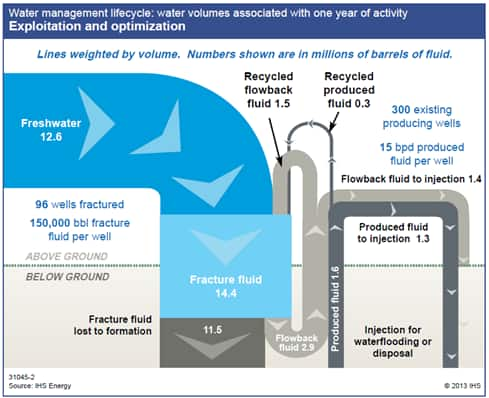
The exploitation and optimization phase is often described as the manufacturing phase of E&P activity. The increased drilling density and higher demand for fracture fluids encourage reuse and recycling of oilfield wastewater. Infill drilling programs move quickly and present significant vulnerability to supply chain interruptions in water sourcing. Valuing mobility and flexibility, operators may opt to find and secure multiple sources for water. They may also integrate mobile treatment systems and modular above-ground storage options with existing fixed water management infrastructure in an effort to recycle waste fluids and offset source water requirements.
Balancing operational risk, economic performance, and enterprise sustainability within this phase of asset development does not support a one-size-fits-all water management strategy. Water management best practices are often complex and locally developed. As a result, operational plans vary by region and are sensitive to a number of variables. IHS has identified six factors critical in developing optimal oilfield water management strategies:
- Wastewater disposal capacity
- Source water availability
- Wastewater quality
- Wastewater quantity
- Regulatory environment
- and last, but by no means least, fracture fluid chemistry
In subsequent articles we will further explore each of these factors highlighting key trends and regional observations.
Posted 14 January 2014
This article was published by S&P Global Commodity Insights and not by S&P Global Ratings, which is a separately managed division of S&P Global.
{"items" : [
{"name":"share","enabled":true,"desc":"<strong>Share</strong>","mobdesc":"Share","options":[ {"name":"facebook","url":"https://www.facebook.com/sharer.php?u=http%3a%2f%2fssl.ihsmarkit.com%2fcommodityinsights%2fen%2fci%2fresearch-analysis%2foptimizing-water-management-through-the-phases-of-asset-development.html","enabled":true},{"name":"twitter","url":"https://twitter.com/intent/tweet?url=http%3a%2f%2fssl.ihsmarkit.com%2fcommodityinsights%2fen%2fci%2fresearch-analysis%2foptimizing-water-management-through-the-phases-of-asset-development.html&text=Optimizing+water+management+through+the+phases+of+asset+development","enabled":true},{"name":"linkedin","url":"https://www.linkedin.com/sharing/share-offsite/?url=http%3a%2f%2fssl.ihsmarkit.com%2fcommodityinsights%2fen%2fci%2fresearch-analysis%2foptimizing-water-management-through-the-phases-of-asset-development.html","enabled":true},{"name":"email","url":"?subject=Optimizing water management through the phases of asset development&body=http%3a%2f%2fssl.ihsmarkit.com%2fcommodityinsights%2fen%2fci%2fresearch-analysis%2foptimizing-water-management-through-the-phases-of-asset-development.html","enabled":true},{"name":"whatsapp","url":"https://api.whatsapp.com/send?text=Optimizing+water+management+through+the+phases+of+asset+development http%3a%2f%2fssl.ihsmarkit.com%2fcommodityinsights%2fen%2fci%2fresearch-analysis%2foptimizing-water-management-through-the-phases-of-asset-development.html","enabled":true}]}, {"name":"rtt","enabled":true,"mobdesc":"Top"}
]}