Customer Logins
Obtain the data you need to make the most informed decisions by accessing our extensive portfolio of information, analytics, and expertise. Sign in to the product or service center of your choice.
Customer Logins

BLOG
Oct 24, 2012
Natural gas emissions estimates – Accuracy improvements discussed at EPA stakeholder workshop
The U.S. Environmental Protection Agency’s (EPA) estimates of methane emissions from completions of hydraulically fractured wells have generated a great deal of controversy in the past few months. IHS entered the fray with its report Mismeasuring Methane, challenging the data and methodology that EPA used and suggesting that they are likely overestimating natural gas emissions.
The EPA seems to be listening. On September 13 - 14 EPA held a stakeholder workshop to discuss its methodology for estimating methane emissions from all natural gas operations with participants from industry and industry associations, NGOs, and the technical community. Emissions from well completions were a hot topic of discussion.
So how does EPA estimate methane emissions from well completions? They use a 3-step process. First, they estimate the emissions that would occur from each well in the absence of any mitigation measures. Second, they calculate the emissions that were mitigated based on state laws and voluntary emissions reductions reported to EPA’s Gas STAR program. Finally, these mitigated emissions are subtracted from the unmitigated total to produce the final emissions estimate. However, participants at the workshop took issue with EPA’s unmitigated emissions estimate and the estimate of emissions mitigated.
For the first step, the unmitigated emissions calculation was based on reports to Gas STAR of methane captured during “green completions,” during which all methane produced during the completion process is captured for sale. Several operators made the point that not all of the captured methane reported to Gas STAR would have been emitted without the green completion process, because some of that methane would have been captured for sale. The Gas STAR reports included an average of 9 days of emissions, but one operator pointed out that in non-green completions, wells are hooked up to gathering lines after an average of 3.5 days, rather than 9. (See the schematic below.) The theoretical question of “when does flowback end?” matters in this case, and the incentives are different when an operator is reporting emissions reductions to EPA vs. deciding when it is economical to hook up the well to gathering lines for sale.
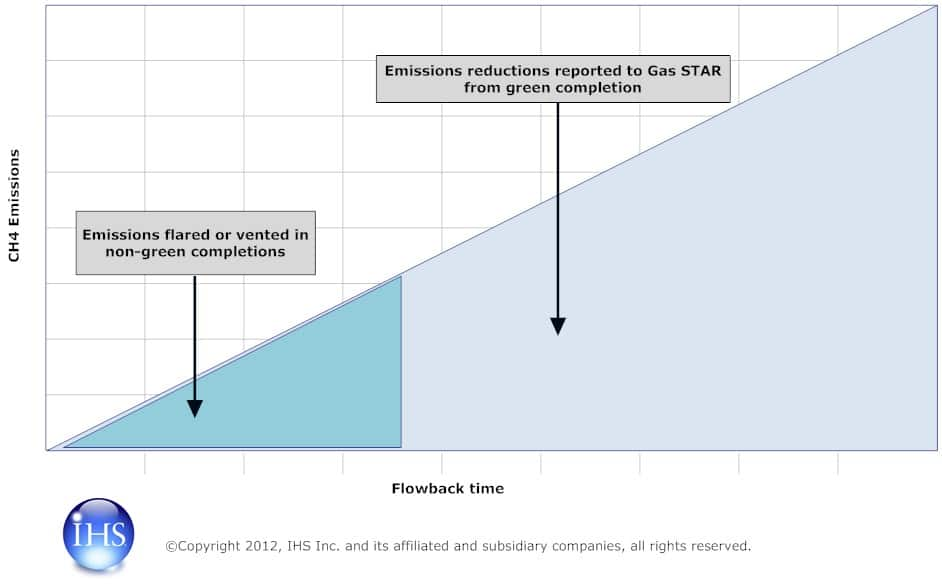
Operators report mismatch in gas volumes reported to Gas STAR and volumes that would have otherwise been emitted.
Source: IHS
Questions surrounding quantity of methane flared or captured
Participants in the workshop also questioned the reliance on Gas STAR data and emissions mitigation measures required by state laws to estimate the quantity of methane that is flared or captured during the well completion process.
The capture or flaring of methane during completion is not just a question of environmental performance, it’s also a question of well-site safety and economics. Operators are likely to capture or flare methane during completion on many more occasions than are required or reported to environmental programs like Gas STAR to ensure methane does not approach the lower explosion limit, as well as limit the loss of this valuable fuel.
Better data is the solution to this controversy ...and better data is on the way. Subpart W of the Mandatory Greenhouse Gas Reporting Rule requires entities in the oil and gas industry that exceed certain emissions thresholds to monitor and report their emissions. The first of these reports were due at the end of September. Although these reports will not arrive in time to be a part of EPA’s 2013 economy-wide greenhouse gas emissions report, they will be analyzed and used in future reports. In addition, several studies that measure actual emissions from various parts of the natural gas value chain are underway, funded by industry groups, academia, and NGOs.
Positive steps to optimize accuracy The workshop was collegial and constructive, and all sides showed a willingness to discuss the best methodology for emissions estimates. EPA officials stated that they will need to analyze the data that comes in as part of Subpart W reporting to understand how they will incorporate it in future emissions estimates. Nonetheless, EPA showed a willingness to revise its methodology as better data emerges. For example, EPA is reducing the assumed workover rate (the percent of operating wells that are re-fractured and re-completed each year) from 10% to 1% based on updated industry data, which will result in a substantial reduction in estimated emissions from well completions.
EPA’s workshop was a positive step in furthering our understanding of the full life-cycle greenhouse gas emissions from natural gas systems and in ensuring that the overall emissions estimate is as accurate as possible, and demonstrates a good faith effort by the EPA to ensure an accurate dataset for the basis of policy and regulation.
This article was published by S&P Global Commodity Insights and not by S&P Global Ratings, which is a separately managed division of S&P Global.
{"items" : [
{"name":"share","enabled":true,"desc":"<strong>Share</strong>","mobdesc":"Share","options":[ {"name":"facebook","url":"https://www.facebook.com/sharer.php?u=http%3a%2f%2fssl.ihsmarkit.com%2fcommodityinsights%2fen%2fci%2fresearch-analysis%2fnatural-gas-emissions-estimates-accuracy-improvements-discussed-at-epa-stakeholder-workshop.html","enabled":true},{"name":"twitter","url":"https://twitter.com/intent/tweet?url=http%3a%2f%2fssl.ihsmarkit.com%2fcommodityinsights%2fen%2fci%2fresearch-analysis%2fnatural-gas-emissions-estimates-accuracy-improvements-discussed-at-epa-stakeholder-workshop.html&text=Natural+gas+emissions+estimates+%e2%80%93+Accuracy+improvements+discussed+at+EPA+stakeholder+workshop","enabled":true},{"name":"linkedin","url":"https://www.linkedin.com/sharing/share-offsite/?url=http%3a%2f%2fssl.ihsmarkit.com%2fcommodityinsights%2fen%2fci%2fresearch-analysis%2fnatural-gas-emissions-estimates-accuracy-improvements-discussed-at-epa-stakeholder-workshop.html","enabled":true},{"name":"email","url":"?subject=Natural gas emissions estimates – Accuracy improvements discussed at EPA stakeholder workshop&body=http%3a%2f%2fssl.ihsmarkit.com%2fcommodityinsights%2fen%2fci%2fresearch-analysis%2fnatural-gas-emissions-estimates-accuracy-improvements-discussed-at-epa-stakeholder-workshop.html","enabled":true},{"name":"whatsapp","url":"https://api.whatsapp.com/send?text=Natural+gas+emissions+estimates+%e2%80%93+Accuracy+improvements+discussed+at+EPA+stakeholder+workshop http%3a%2f%2fssl.ihsmarkit.com%2fcommodityinsights%2fen%2fci%2fresearch-analysis%2fnatural-gas-emissions-estimates-accuracy-improvements-discussed-at-epa-stakeholder-workshop.html","enabled":true}]}, {"name":"rtt","enabled":true,"mobdesc":"Top"}
]}